
Making quantum power accessible
Qinara is delivering tomorrow’s performance today. This trailblazing team, who met at the University of Edinburgh, combine classical and quantum computing to enhance the accuracy and efficiency of artificial intelligence (AI) models – delivering data-driven solutions that are spurring breakthroughs in everything from biomedicine and cybersecurity to finance. Qinara’s work means industries can embrace the benefits of quantum technology without the high costs and hardware limitations. AI model performance is enhanced by 40% and computational costs cut by 70%.
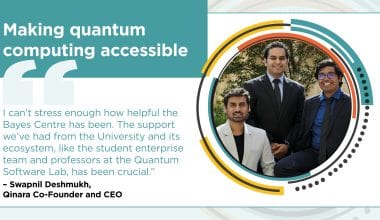
Qinara co-founder and CEO Swapnil Deshmukh said: “I can’t stress enough how helpful the Bayes Centre has been. The support we’ve had from the University and its ecosystem, like the student enterprise team and professors at the Quantum Software Lab, has been extremely crucial.
“Our goal is to make quantum accessible. Our first product, Qronos, is a quantum circuit optimiser. It takes big quantum algorithms and compresses them so you can run it on current NISQ (noisy intermediate-scale quantum) hardware, which is limited. We bring the value of the future to the present by making the circuits smaller and removing the errors. “Our second product, Q-PRISM, is a cybersecurity product, developed to prepare classical computers to fight future quantum attacks.
“Our third application, Qure, is a drug discovery platform. A family member received a cancer diagnosis in 2016 and has to take a medicine called anastrozole, which has a lot of side effects. My idea was to use a quantum-based inference model to create a drug discovery platform to find drugs with fewer side-effects. We’re also looking into enhancing early detection of cancer.”
Qinara’s successes are remarkable – even more so given the company formed only two years ago, after Mr Deshmukh teamed up with friends Satwik Dalvi and Rahat Santosh to participate in the 2024 MSc Challenge, co-hosted by the School of Mathematics and industry partner Space Intelligence. He said: “The task was to predict deforestation using satellite data. We used quantum SVM (support vector machine), a small algorithm that can work on classical machines. The accuracy was off the charts. With classical, we got 34% accuracy – with quantum, it was 97%.” But while the team showcased the power of quantum computing, the project also highlighted its expense and that it was not yet scalable.
“Quantum is hardware dependent,” Mr Deshmukh explained. “Our idea was, while we have small quantum computers, if we apply a certain approach we can make them more accessible.”
Qinara’s approach led to the development of products Qronos, Q-PRISM and Qure. But the team needed to go from data-driven idea to market-ready business, so in 2024 applied to join the Bayes Centre’s Venture Builder Incubator (VBI), which is funded through the DDI programme.
VBI offered strategic guidance and support in areas such as legal and intellectual property. Mr Deshmukh said: “We’ve had help in business planning, financial readiness and value proposition. “Explaining quantum to people and investors who are not familiar with the topic is extremely difficult, so the support to explain better has helped us come a long way.”
Qronos released its benchmark results on Quantum Insider in November 2025, positioning it as the current global leader in quantum circuit optimisation. Qinara, based in Edinburgh, is now looking for further investment partners. IBM has expressed interest in Qronos, while funding has been received from Scottish Enterprise. Mr Deshmukh said: “If you use a quantum computer and train that model for four or five days, it would cost £20,000. If you use Qronos, that would come down to £1,000, while reducing errors. “One of the major applications of quantum computing will be in cybersecurity. You can also use it to prepare classical computers, which is what we’re doing with Q-PRISM. “Our next steps are to bring quantum power into greater use.”
For more information and to contact the Qinara team, visit qinara.co.uk Learn more about VBI at hub.bayes. ed.ac.uk/programmes/vbi
Read the latest Case studies

Introducing systems convening
Across Scotland’s public services, there are increasingly rich data sets on health, education, housing, justice,…

Compassionate financial services
The “science of compassion” is being harnessed to help create a more inclusive and sustainable…

Learners are reaching for the stars
Ever wanted to do something out of this world? Help to launch a career in…