
The next frontier in subsea safety
Navigating the murky depths of the seabed to inspect the foundations of subsea structures is a costly, arduous and dangerous job, even with underwater robots, also known as remotely operated vehicles (ROVs).
However, the process has been made safer, simpler and faster thanks to Frontier Robotics’ new technology that provides enhanced perception, automation and autonomy for ROVs. This was developed as part of the ORCA (Offshore Robotics for the Certification of Assets) Hub.
This major UK research initiative ran between 2017 and 2022, aimed at developing AI and robotics for the offshore energy sector. It was led by the Edinburgh Centre for Robotics (Heriot-Watt University/ University of Edinburgh), with Imperial College London, Oxford and Liverpool Universities partnering with more than 30 industry firms to revolutionise Asset Integrity Management for offshore energy, using robotics and AI for safer and more efficient inspection, maintenance and repair.
David Wavell, Frontier Robotics’ Co-founder and Chief Operating Officer, said: “We call our technology AUIP – Autonomous Underwater Inspection Payload. “It essentially consists of a pair of specially designed optical cameras combined with a computational unit and our specialist software embedded that can be ‘plugged in’ to an ROV, upgrading it with advanced sensing and autonomous capabilities. Think of it like the eyes and brains for underwater inspection robots.”
Inspection
During the ORCA Hub project, the team involved in developing AUIP carried out the offshore wind industry’s first fully autonomous inspection of an offshore turbine foundation, alongside EDF Renewables in 2021.
The industry interest was the catalyst to spin- out the company in 2023 and turn a high-quality research prototype into a commercial product. Such improved monitoring enables operators to make faster, better-informed decisions about maintenance operations, reducing both costs and carbon footprint.
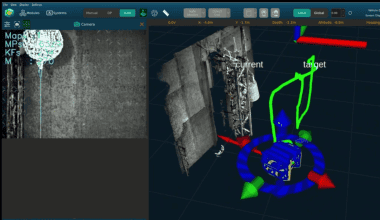
By leveraging advanced sensor fusion techniques with edge computing, Frontier Robotics’ system offers enhanced visual clarity, robust and reliable positioning and 3D mapping through Simultaneous Localisation and Mapping (SLAM) technology.
Mr Wavell said: “SLAM builds a 3D model of the environment the ROV is trying to inspect, then allows the ROV to localise itself within that model. With our technology, you get the automation of the vehicle and a 3D model of the environment, which gives the vehicle operator a much more comprehensive understanding.”
Economic value
Since the spin-out, Frontier Robotics has been based at The National Robotarium in Edinburgh. Mr Wavell said: “Not only does the National Robotarium incubate new start-ups but it also supports new companies trying to take technology into market and, in doing so, creates new businesses, jobs and economic value. “We all benefit from the support, particularly networking.”
Mr Wavell added: “We know from our customers that our technology is better than anything else on the market. However, we don’t think the industry is ready to adopt full autonomy just yet. We plan to incrementally add greater levels of automation so our customers have the confidence to send an expensive ROV on an inspection mission without manual control.”
Learn more by visiting the website frontierrobotics.ai
Read the latest Case studies

Impact of cold homes on child health
Improving the health of Scotland’s children is at the heart of a five-year project from…
Meet ‘Basil’, the robot barista
Residents in an extra care housing facility in Stockton had a surprise visitor when a…

HPC training from global experts
Supercomputers solve complex problems and fuel cutting-edge research and breakthroughs in a range of disciplines…