
Meet ‘Basil’, the robot barista
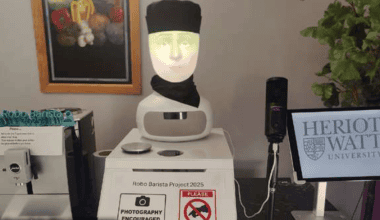
Residents in an extra care housing facility in Stockton had a surprise visitor when a robot ‘barista’ stayed in their community bistro for five weeks, as part of an experiment to see how humans and robots interact in a social setting.
The AI-empowered robot took orders and served beverages to residents through the coffee machine it was connected to, plus engaged people in conversations based on its preprogrammed data bank of local history and the activities coming up at the home.
The residents at Aspen Gardens extra-care housing complex, run by North Star Housing, quickly took to the robot, dressing it up in a catering hat and scarf and naming it ‘Basil’, after the hapless hotel manager in the Fawlty Towers TV show.
Interaction
But behind the novelty was a serious study exploring how people interact with conversational robots in real-world settings – and what that means for the future of customer service, healthcare support and companionship.
Dr Theodoros Georgiou, Assistant Professor in the Computer Science department at Heriot-Watt University and part of the National Robotarium, explained: “Robots are increasingly appearing in public places, homes and workplaces but we still don’t know much about how people react to them in everyday situations. Our aim at Aspen Gardens was to understand how people interact with robots and look at how aspects such as the robot’s personality and storytelling affect how people respond to it.
“We can learn what helps people feel comfortable, what encourages trust and what might put people off. This can guide the design of robots that are easier to use, more helpful and more accepted in society, especially in community care or customer-facing roles.”
The study used a Furhat ‘head and shoulders robot’. Life-like facial animations enable it to make eye contact, hold conversations and respond naturally to people.
Dr Georgiou said: “We’ve been testing whether simple narratives can change how engaged people feel, how they relate to their robot and how well they remember information the robot is giving them. We collected more than 50 interactions from 39 people at Aspen Gardens, with several returning more than once – the only negative comment we had was that ‘Basil’ did not make hot chocolate! “Now we have a robot set-up we can reuse for future studies.”
Expanding
Dr Georgiou and his team – which includes Dr David Robb, Research Fellow at Heriot-Watt University, and PhD candidate Bruce Wilson from the Edinburgh Centre for Robotics – are expanding their research to see how other groups of people interact with robots, to expand the existing data on real human–robot interactions.
He said: “The DDI initiative has been pivotal to our research as it has connected us with the right people, helped us access funding and opened the door to running a study in a real community space.”
Dr Georgiou added: “We are looking to replicate the experiment in a demographic closer to college age. We’re interested to investigate whether narrative can influence small choices and can be persuasive, for example, whether a customer follows a suggestion made by the robot.
This will help us to grow our data set and share the results, to help guide new social robots and how they are designed. “What matters most is that this work isn’t just happening in a lab. It’s happening with real people, in real places. If we can understand what helps people feel comfortable and engaged with robots, we can design technologies that support them in meaningful ways and take away some of the burden from overstretched services within the health and social care sector.”
Read the latest Case studies
Impact of cold homes on child health
Improving the health of Scotland’s children is at the heart of a five-year project from…
The next frontier in subsea safety
Navigating the murky depths of the seabed to inspect the foundations of subsea structures is…

HPC training from global experts
Supercomputers solve complex problems and fuel cutting-edge research and breakthroughs in a range of disciplines…